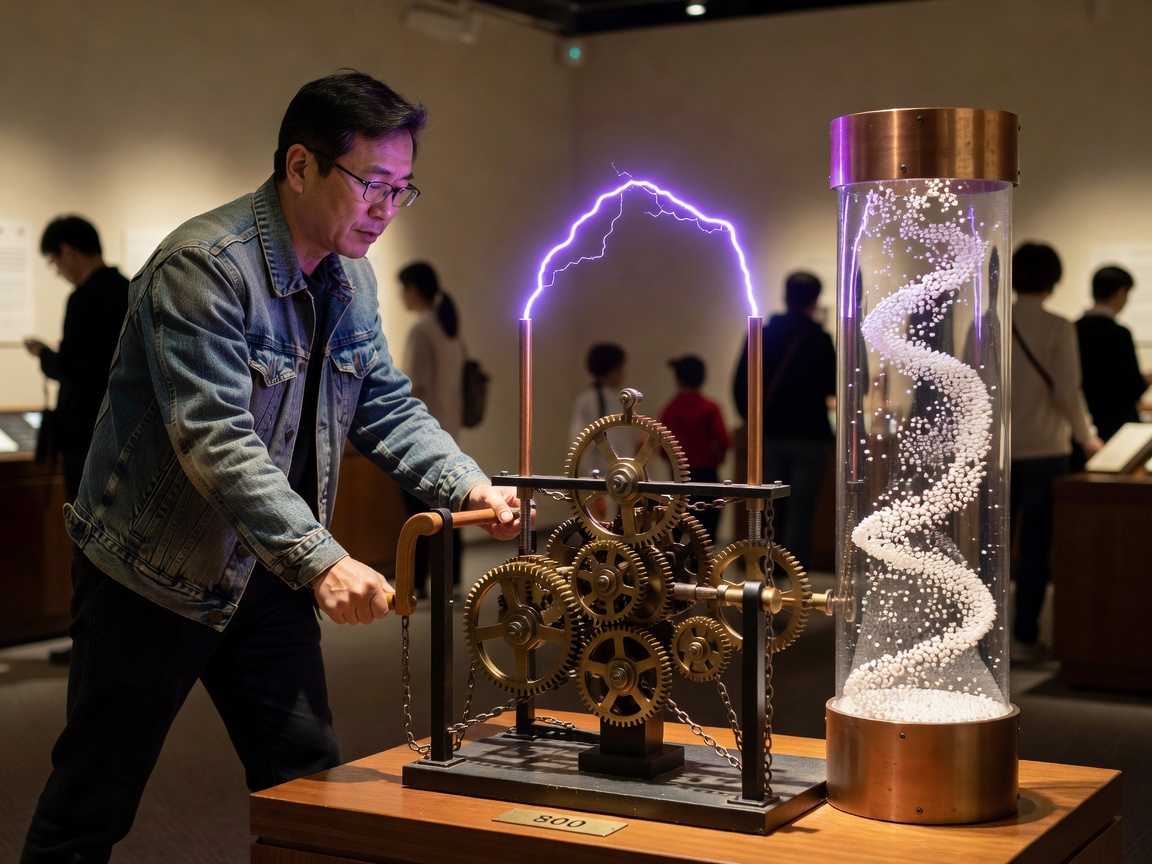
What interaction adds
An interactive exhibit turns a visitor into a variable in the system. Pull a lever, change a setting, stand in a marked position or compare two results. The response gives an immediate route into concepts such as force, friction, pressure, sound, light, probability and energy transfer.
The best installations make the relationship legible. A control has a clear purpose. The response is large enough to notice. A short label explains the principle without replacing the experiment. Some exhibits allow repeated trials, which helps visitors separate a reliable effect from a one-off surprise.
Demonstrations and displays
Live demonstrations add timing and explanation. A presenter can adjust the pace, answer questions and connect a result to a familiar object. Self-guided displays offer more control and usually suit visitors who prefer quiet observation. Both formats have value. Neither guarantees understanding without a useful explanation.
Look for different levels of participation. A button that starts a video is an interaction, but it offers less investigation than a model with adjustable inputs. This distinction matters when planning a long visit. Active exhibits can create fatigue, queues and noise. Build in slower galleries or object displays.
Accessibility and age suitability
Check the museum’s official accessibility information before travelling. Useful details include step-free routes, seating, hearing support, captioning, low-sensory periods, accessible controls and quiet spaces. A gallery can be intellectually suitable while a control remains difficult to reach or operate.
Age labels are guidance, not a measure of ability. Younger visitors may engage through movement and observation. Older visitors may want the underlying mechanism, historical context or a more demanding challenge. Read the museum’s own family and school information. Do not assume every exhibit suits every group.
Interactive or collection-based?
Interactive museums
Useful for: testing principles, group discussion and first contact with science.
Limitations: queues, noise, simplified models and controls that may fail or need resetting.
Collection-based museums
Useful for: material evidence, historical sequence and close study of objects.
Limitations: mechanisms may be static, labels may require more reading and systems can remain invisible.
Good for
- Visitors who learn through doing.
- Families comparing different levels of challenge.
- Teachers introducing a physical concept.
- Adults who want a clear entry point before technical collections.
What to know
- Check current opening, access and timed-entry information.
- Allow pauses between high-energy exhibits.
- Do not treat a dramatic effect as a complete explanation.
- Ask staff when a display is unavailable or unclear.
Related guides
Evaluate science exhibitions → Plan a museum visit →
Need a route for your group?
Send the guide team your interests, access needs and preferred pace.
Contact the guide